Repair, Maintenance, Restoration
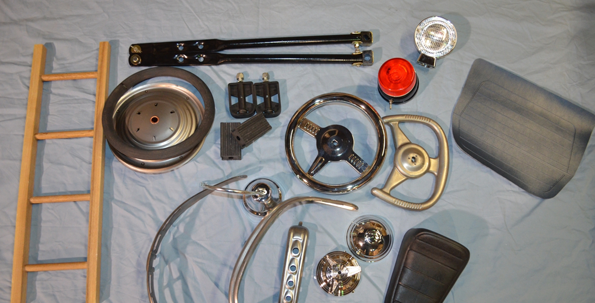
When you have a pedalcar that needs TLC, there are a couple of steps to go through in order to complete the project successfully.
The first step is to identify what kind of car it is so the correct parts can be obtained.
Just like when you need parts for your Chevy, you can’t find them at a Ford dealership, when your Murray needs a new wheel, you have to know it’s a Murray, not an AMF.
We’ve put images of many pedalcars that are being collected and restored today on this website. Go to the identify my car tab, and see if your car is shown there. The important identifier is the body shape. Your car may be a firetruck, and the image we show is a sedan, but the parts will, for the most part, be the same.
Every manufacturer, when they made a pedalcar design, would make multiple versions in order to maximaize sales. There might be one version that looks like a station wagon, one that looks like a fire chief’s car and so on.
If you don’t see one that you recognize, send us a picture of your car, and we can probably tell you what it is, and the availability of parts.
Once you know what kind of car you have, make a list of what parts you need, and give us a call at 248 853 0215. We will do our best to help.
Over the coming weeks, we will be adding hints and suggestions to this link, in the meanwhile here are two ideas that may help.
Two of the more commonly collected pedalcar brands are Murray, and AMF. The first thing I look at in identifying them are the wheels.
Most Murray pedalcars had six tabs on the wheels that held the hubcaps on. The diameter of the hubcaps is 3 3/8 in. The hubcaps were usually steel with an “M” in a circle stamped into the center. Some models had a plastic hubcap in a “starburst” design.
Most AMF cars had plastic hubcaps that were held onto the wheel with three plastic tabs that snapped into the wheel. The hubcap had three spinner bars.
These two brands were the ones produced in the highest volume during the period of 1950 thru 1980. |